1.31.2013

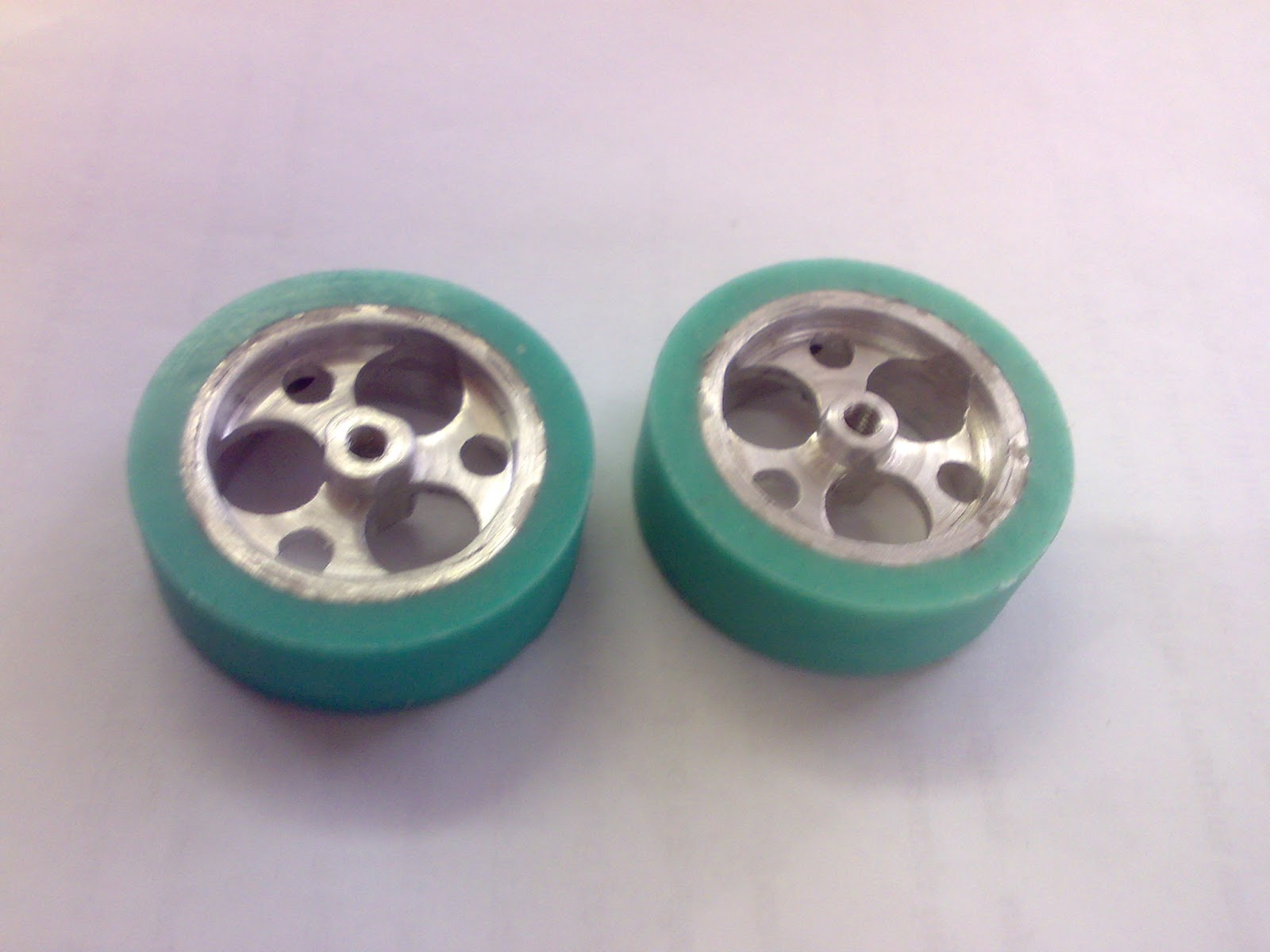
A-Silicone or PU Tires?

Tested polyurethane rubber with the surface of the dohyo, with 32-07 Monitor/Slip and Friction from Testing Machines Inc.
Introduction:
Slip and Friction testing aids in the evaluation of chemicals and additives used to create or minimize the degree of friction between two contacting test specimens.

Applications:
Paper, Flexible Packaging, Foils, Rubber, Plastics, Wood,
Linoleum, Metal, Printing, Coatings, Composites

Specifications:

  • Selectable speed from 5 to 43 cm/min (2 to 17 inch/min)
  • Selectable travel distance from 2.5 to 30.5 cm (1 to 12 in.)
  • Meets TAPPI T816, T549, and ASTM D1894

Features:

  • Digital display, storage and editing of up to 100 readings, and selectable units (COF or grams)
  • Settable limits
  • Statistics-average, standard deviation, high/low results.
  • Report printout with built in printer
  • RS-232
  • Static and kinetic coefficient of friction calculated in one operation.
  • Direct drive arm with unique skid control.
  • Sled-connecting mechanism ensures level pulling action.
  • Easily interchangeable sleds.
  • Full color easy to read Display

Instrument size:
Depth: 495 mm (19.5 in.)
Height: 508 mm (20 in.)
Width: 515 mm (20.3 in.)
Weight 25 kg (55 lb)
PDF product sheet:
Monitor/Slip and Friction

Product Video:

Brief test results:
* TEST REPORT *
Test Name: SL
Date: 31 Jan 2013

Sample ID: -
Sled Type: B - 200g (.44Lb)
Sled Info: -
Speed: 10cm/min
Travel: 20cm
Unit: COF

Total Meas.: 3
Rejected: 0
Static:
 -> Mean: .654
 -> SD: .089
 -> Lo: .601 (#1)
 -> Hi: .758 (#2)
Kinetic:

 -> Mean: 1.536
 -> SD: .210
 -> Lo: 1.410 (#1)
 -> Hi: 1.780 (#2)

Reading #: S K (X=reject)
 1: .601 1.410
 2: .758 1.780
 3: .604 1.420

* END *

Conclusion:
Graph bellow is found from motor parameters, by ramming the robot to the wall.
  1. As expected, static is lower than kinetic friction coefficient.
  2. These aren't final results, because 3 measurements at one speed means nothing.
  3. It is essential to conduct full experiment at different speeds and normal loads, in order to achieve force vs speed load graph and compare with DC motor load graph.
  4. Next: Full experiment conduction with PU and silicone rubbers.


Useful links:

1.30.2013

Rotor Inertia Measurement

How do we measure rotor inertia?
We can calculate it out of free run.

Method:
  • Connect motor to the battery;
  • Measure no-load current;
  • Connect oscilloscope to the terminals;
  • Disconnect the battery;
  • Let the single measurement appear in the oscilloscope.

Results:
We measured free run BEMF dynamic process, which is equivalent for speed.
We can approximate the achieved graph to linear, which will allow us to use approximated differential dynamics:
  1. Main dynamic formula (M_din - dynamic torque, M_t.v. - no load torque).
  2. Useful torque.
  3. Dynamic Torque equal to No Load Torque.
  4. Torque and current link.
  5. EMF and angular velocity link.
  6. Voltage balance equation.
Moment of inertia is equal to:

Where I_t.v. - no load current, k - motor constant, T - time, E_bat - battery EMF, r_a - armature resistance, r_bat - battery resistance.

Simulation:
Simscape electrical in Matlab, helps us to have this approximated dynamic process and calculate the rotor inertia, which is equal to 1,081e-4 kgm^2:
Conclusion:
This is quite accurate method for rotor inertia calculation, if the gearmotor has static load (friction), which linearised the exponential graph of the speed.

Cast Silicone Tires

Casted new tires with Elite Double 22 from Zhermack

A-Silicone for laboratory model duplication. Ideal for duplicating models with slight undercuts and casting investments. Use of a plastic duplication flask is recommended. Available in light green for better definition of detail.

Advantages:
  • Mixing facilitated by the 1:1 base to catalyst ratio;
  • High fluidity: does not require mixing in a vacuum;
  • Absolute precision for faithful reproduction of detail;
  • Dimensional stability over time and non-deformability, allowing a number of duplications to be made;
  • Compatible with all plasters, polyurethane resins, phosphate investments and acrylic resins.

Characteristics:
  • Extreme fluidity;
  • Versatile, thanks to the 22 Shore A hardness;
  • Light green colour.

DOWNLOAD:
Center the rims in the form, and apply the mixed liquid to the gap. Polimerisation shouldn't take long, about half an hour. In the result we get newly casted tyres with perfect friction (while new).


1.04.2013

Block Diagram


Electrical energy source ES feeds programable logic controller together with the voltage feedback. Electrical energy flows to both drivers D, which are controlled with PLC and regulate the power for the motors M, where the energy is converted to mechanical. Both motors drive a single transmission device TD, which is actually a full robot mechanical system, except motors, and a Dohyo together, energy parameters are transformed to fit the work unit WU, wich is an opponents robot system and a Dohyo ring too.
The force you need to push the opponent have to be bigger than critical friction force of the opponent's wheels and the Dohyo surface.

Conclusion:
You don't need an enormous power for motors, only slightly bigger than the product of critical friction force of your TD and prefered nominal speed (e. 10cm/s, depends on termal ability, should not overheat).

12.26.2012

SolidWorks Drawings Update

This documentation is required for my cource work. I use SolidWorks Drawings, user friendly environment and fast view creation, drawings made in no time.
The file is in CAD design section. 2012.12.‎31, ‏‎20:43:38

12.15.2012

Acceleration

When I first tried to launch this robot, I've set the full speed to have a good show.
But I've noticed that the front had been raised significantly at full thrust.
If my robots front is raised each attack state, he's dead from the start.

It needs a Soft Start, maximum acceleration allowed to drive the platform.

Recently I've been playing to solve that problem.
Robot has tactile surface sensors - micro switches, which deactivate if the front is raised.

With the help of MegunoLink Tool, Analog reading, Serial communication and code adjustment, we can make an experiment. The Report is bellow.

My course project asks for 20:1 speed regulation range, so speed is 5% steps discrete.
A delay between steps is adjusted.

Adjustment results:
  • Full thrust: No Soft Start applied, as you already noticed that the front has raised, Switch1 readings shows that 0 value, which is OFF. 270ms flying.
  • 1 ms between steps: Not enough yet, 237ms flying.
  • 2ms between steps: 220ms flying blade.
  • 3 ms between steps: 193ms flying blade
  • 4 ms between steps: 159ms max flying blade, unstable yet.
  • 5ms between steps: Eureka the Golden middle! No flying blades.
Conclusion:
It might be better to add a millisecond as 20% more in reserve, because the dead zone for switches is 2mm (~0.1") between flying blade and surface. Rate of voltage change should be 92.5~111 V/s, provides a Soft Start for motors.

Update 2013.01.03: Another more accurate way to find out if the blade is being raised:
  1. Place a sheet of standard A4 paper on the surface of Dohyo in front of the vehicle;
  2. Soft start it to full speed;
  3. Do it several times;
  4. If the blade gets on top of the paper, that means it is still being raised, add a millisecond or two between 5% PWM duty cycle steps.
  5. If the paper is being pushed only, configuration is over and you're good to go.

Battery Resistance Measurement

Decided to check out the current peaks and measure the voltage drop on the battery.
The currents FB_L and FB_R are different, because motors have a little difference resistances.
Update 2013.01.04: Motors have the same resistance, the problem is somwhere in the right motor's power line, might be the R_DS(ON) Resistance of the H-bridge, because one of them was prieviously used. Soldering a fresh MC33887 may solve the problem.

Peak currents are 1,69A and 1,33A
Voltage before load 11,74V
Voltage during load 10,37V
So resistance R=(11,74-10,37)/(1,69+1,33)=0,454 Ohm

May be I'll add negative voltage feedback, to compensate the error during loads someday in future.

Love this feature.